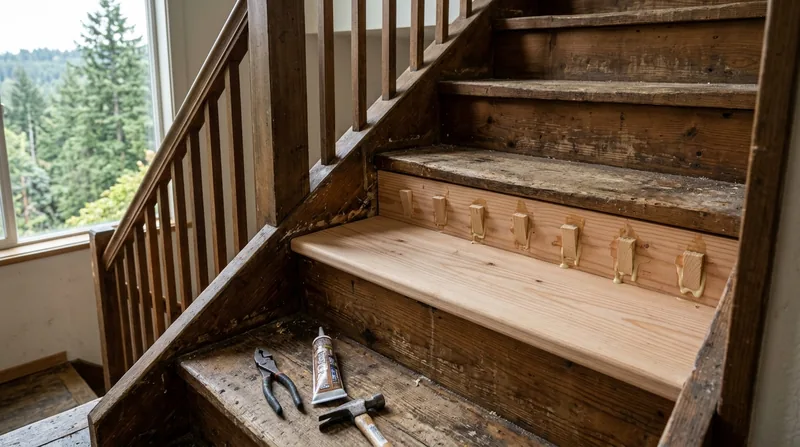




Eugene's steep hillside homes and split-level ranches climb terrain that demands solid stairs and railings. Whether you live in a Craftsman bungalow on the Jefferson Westside, a post-and-beam home under Spencer Butte, or a mid-century ranch in the South Hills, worn treads, loose balusters, and sagging stringers are common failures that get worse with every step. Stair and railing repair in Eugene keeps your family safe, prevents further wood damage, and restores the character of period staircases that define these homes. We rebuild squeaky treads, reinforce stringers, restore original railings, and install sturdy handrails and attic ladders. Most jobs start with a site visit to see what can be saved and what needs replacement.
Why Stair and Railing Repair Matters in Eugene's Older Homes
Eugene's building stock includes decades of wood construction over damp crawlspaces and on wet hillsides. Staircases built in the 1920s, 1950s, and 1970s sit in unheated entry vestibules, garages, and basements where moisture lingers for months. Douglas fir stringers and treads absorb that dampness, swell, shrink, and warp. Balusters work loose in their mortises. Handrails separate from newel posts. Attic ladders sag and stick. Beyond comfort, loose stairs are a safety issue. A soft or rotted stringer can fail suddenly under weight. A loose baluster can swing outward, especially in homes with young children or elderly residents.
- Squeaking treads signal movement between tread and stringer, a sign of moisture and wood movement that worsens over years.
- Loose balusters and newel posts indicate failed joinery, often from swelling and shrinking in humid climates like the Willamette Valley.
- Sagging or cracked stringers mean the structural member is weakening and needs reinforcement or replacement to remain safe.
- Worn tread edges and handrail surfaces are cosmetic but also functional, reducing grip and increasing slip risk on steep stairs.
- Attic ladders and pull-down stairs develop stiff hinges, cracked frames, and worn treads after decades of use in unheated spaces.
Addressing these issues early prevents safety hazards and stops wood damage from spreading to the surrounding structure.
Key info: A staircase that squeaks or moves underfoot is not just annoying. It signals that fasteners are loosening, joinery is separating, and the wood is moving with seasonal moisture. In Eugene's rainy climate, that movement accelerates rot and structural failure. Catching it early is far cheaper than replacing a stringer or rebuilding an entire run.
For more on moisture-driven wood failures in Eugene homes, see our wood rot and dry rot repair service.
How We Repair and Rebuild Stairs in Eugene
Our process starts with a careful site inspection. We identify which parts can be saved, repaired, or reinforced, and which need replacement. We test treads for soft spots, check stringers for rot or cracks, examine joinery for movement, and assess railings for safety and structural soundness. Once we understand the scope, we propose repair first, replacement only where the wood will not hold. This approach preserves the character of original staircases and keeps costs down when repair is the honest answer.
- We tighten loose balusters by reinforcing mortise-and-tenon joints with epoxy, shims, or new fasteners driven from below to remain invisible.
- We repair squeaking treads by driving shims and screws from underneath the stringer to eliminate movement and restore a solid feel.
- We reinforce soft or cracked stringers by sistering new lumber alongside the damaged member, bolting them together to share the load.
- We replace individual worn treads or risers by scribing new wood to match the original profile and fitting it into the existing stringer mortises.
- We restore period railings by repairing newel posts, replacing broken balusters in kind, and refinishing handrails to their original wood species and finish.
- We install new handrails, attic ladders, and safety railings to meet current building codes and your family's grip and access needs.
Each repair is tailored to the staircase, the wood species, and the home's original design language.
Local example: A Craftsman bungalow in the Whiteaker with a built-in bookcase under the stair and original quarter-sawn oak balusters came to us with three loose spindles and a squeaking tread. We reinforced the newel post, tightened the balusters using epoxy in the mortises, shimmed the tread from below, and refinished the handrail. The whole staircase felt solid again, and the original character was preserved. Cost was a fraction of replacing the entire run.
For structural framing work on load-bearing walls or major stair reconstruction, see framing and structural carpentry.
Stair and Railing Repair Methods
| Approach | Description | Best for |
|---|---|---|
| Tightening and shimming | Driving shims and fasteners from below or behind to eliminate movement and squeaking without altering the visible surface. | Squeaky treads, loose handrails, minor movement in balusters and newel posts. |
| Epoxy reinforcement of joinery | Injecting epoxy into mortise-and-tenon joints to lock loose balusters, newel posts, and handrail brackets in place and restore structural integrity. | Loose or wobbly balusters, separated newel posts, original period railings worth preserving. |
| Sistering stringers | Bolting new lumber alongside a cracked or softened stringer to share the load and restore structural capacity without removing the stair. | Sagging or cracked stringers, soft wood from rot or moisture, stairs that flex or feel unsafe underfoot. |
| Tread and riser replacement | Removing worn or damaged treads and risers, scribing and fitting new lumber to match original profiles, and securing into existing stringer mortises. | Worn, splintered, or rotted treads, split risers, stairs that need cosmetic restoration and renewed safety. |
| Handrail and railing restoration | Repairing or replacing balusters, newel posts, and handrails in original wood species and style, refinishing to match existing surfaces. | Period railings, broken or missing balusters, handrails that need refinishing or reinforcement for grip and safety. |
| Attic ladder and pull-down stair repair | Replacing hinges, lubricating joints, reinforcing frames, replacing worn treads, and testing operation to ensure smooth and safe access. | Stiff or stuck attic ladders, cracked frames, worn treads, hinges that bind or fail to hold the ladder open. |
Stair and Railing Repair Cost in Eugene: What to Expect
Stair and railing repair costs depend on the scope of work, the condition of the wood, and whether you are repairing existing joinery or replacing structural members. A simple tightening of loose balusters or shimming of squeaky treads starts at around $600 to $900. Reinforcing a stringer with epoxy or sistering new lumber, or replacing multiple treads, typically runs $1,200 to $2,500. Full staircase rebuilds, including new stringers, treads, and railings, can exceed $4,000 depending on the run length, wood species, and finish detail. Attic ladder repair is usually $300 to $600. Travel is included in Eugene and surrounding areas, and we provide a free estimate within 24 hours.
Several factors move the price within these ranges. The condition of the existing wood determines whether repair is viable or replacement necessary. Access to the underside of the staircase affects labor time. The wood species (Douglas fir, oak, redwood, cedar) and finish detail (simple paint, original stain, period-appropriate refinish) influence material and labor costs. Safety requirements and code compliance for railings and handrails may require reinforcement or new installation. If the staircase is in a heritage home or protected area, permits may be required, and we can help you navigate that process.
The best way to understand your costs is to contact us for a free estimate. We'll inspect the staircase, identify the repair options, and give you a clear price range before we start work. For a full overview of pricing across our services, see our pricing page.
Stair and Railing Repair Near Me: What Eugene Homeowners Should Know When Hiring a Carpenter
Hiring the right carpenter matters for safety and quality. Look for a contractor who is fully insured and can show proof of coverage. Ask for references from recent stair repair or railing work, and call them to ask about the quality of the repair and whether the staircase feels solid and safe. Get at least two estimates so you can compare scope, materials, and price. If your home is in a historic district or subject to homeowners association rules, check whether the repair requires approval before you book. For major structural work like replacing stringers or altering railings, your local building department may require a permit, so ask the contractor whether permits are needed and who handles the application.
- A fully insured carpenter carries liability and workers compensation coverage, protecting you if someone is injured or property is damaged during the work.
- References from past customers tell you whether the repair held up, whether the contractor communicated clearly, and whether the work matched the estimate.
- Multiple estimates help you spot low-ball bids that cut corners or high-ball bids that don't match the scope, and they let you compare repair versus replacement options.
- Permit requirements vary by location and scope, so ask your contractor whether the work needs approval before starting, and defer to your local building department for final rules.
- A clear contract spells out the scope, timeline, materials, payment schedule, and warranty, so there are no surprises when the work is done.
When you are ready, call us at (541) 636-9499 or visit our contact page to request a free estimate. We'll inspect your staircase, explain what we find, and give you honest repair and pricing options.
Stair & Railing Repair in Eugene: Pricing Guide
| Service | Price | Details |
|---|---|---|
| Tightening and shimming loose treads or balusters | Starting at $600 | Shims and fasteners driven from below or behind to eliminate squeaking and movement in existing stairs. |
| Epoxy reinforcement of balusters or newel posts | Starting at $800 | Injecting epoxy into mortise-and-tenon joints to lock loose railings in place and restore joinery integrity. |
| Sistering stringers or replacing treads and risers | Starting at $1,200 | Reinforcing or replacing structural members and worn treads, labor and material cost depending on run length and wood species. |
| Full staircase rebuild or major railing restoration | On estimate | New stringers, treads, railings, and handrails require site inspection to assess existing condition and scope before a firm price. |
| Attic ladder and pull-down stair repair | Starting at $300 | Replacing hinges, lubricating joints, reinforcing frames, and replacing worn treads to restore smooth and safe operation. |
| Travel and estimate | Included and free | No mileage fee in Eugene and surrounding areas, free estimate within 24 hours with no obligation to book. |
Indicative pricing, the exact cost depends on square footage, finish, and site access. Free personalized estimate within 24h at (541) 636-9499.


